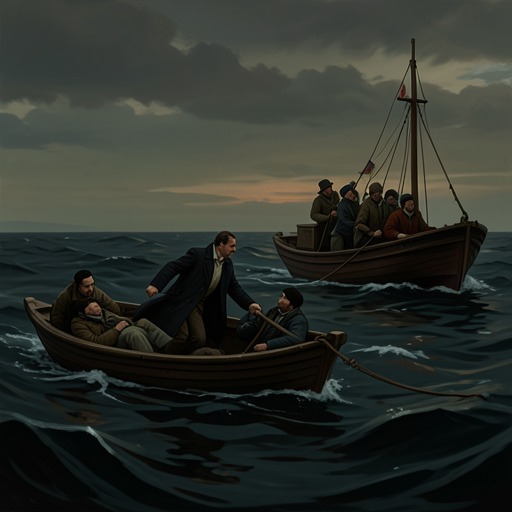
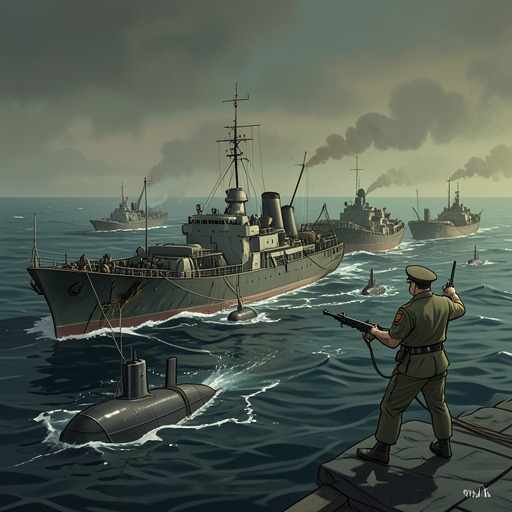
Keeling rescues survivors from the burning wreck
The Good ShepherdKeeling rescues survivors from the burning wreck after a cry for help turns an already dangerous naval situation into an immediate choice about whom the ship can risk saving. Krause weighs the threat to Keeling and its crew against the lives in the water, then orders the destroyer back. The rescue succeeds: four men are recovered and sent to the doctor, making the episode both a practical operation and a test of command under competing obligations.
The sighting and the danger
The first indication of survivors is a distant cry, followed by the port lookout’s report of an object close to the bow. In the darkness, Krause cannot establish at once what is floating there or how many people it holds. He reasons that survivors may have escaped the wreck in a life-raft and been left behind as the ship drifted away, but this remains an estimate made under pressure, not a certainty. The explosion that destroyed the ship has left a small, difficult-to-locate target on the water; whatever the men’s chances of surviving the blast, exposure threatens them with death soon after.
The nearest apparent alternative is Cadena, about a mile away. Alerting the rescue ship would require Keeling to approach and hail it by bullhorn, and Krause doubts it would be able to find the survivors. More gravely, bringing Cadena back would place it within a submarine’s torpedo range. His calculation is therefore not simply whether rescue is desirable, but whether one ship can be risked to save people whose exact number and location are unknown. The episode keeps that uncertainty in view: the men are not yet a confirmed group that can be counted, but a cry and a dark object amid the wreckage.
Krause’s decision
Krause initially measures the danger in stark terms. He considers Cadena and Keeling more valuable than the uncertain number of survivors, reasoning that the escort ships’ continued service protects many merchant seamen. Yet the calculation does not settle the matter. He also recognizes the intrinsic value of the lives in the water, the effect that abandoning them would have on his own crew, and the importance of an act of rescue to Allied solidarity. These considerations do not erase the danger; they give it a human and institutional cost beyond the ships themselves.
He orders a hard turn to starboard and asks for a course that will bring Keeling back to the position. The order comes quickly, in a passage that compares the movement to a fencer’s response to an opponent’s feint and attack. Krause’s readiness also draws on a hundred peacetime man-overboard exercises: training has made the difficulties of such a recovery familiar and the need for immediate action clear. He then orders the engines to one-third speed, setting a controlled approach in motion rather than leaving the decision at the level of deliberation.
The recovery
The approach requires Keeling to stop in the water. The engines are reported stopped while ASDIC sonar continues pinging; the ship rolls dead in the water as the crew listens for what can be heard from the port side. After several difficult seconds, Wallace reports that all the survivors are aboard. Krause checks that the ship’s side is clear and receives confirmation that Keeling can get under way. The sequence shows the rescue as a coordinated shipboard task: the turn and approach bring the destroyer alongside, while the order to stop creates the brief interval needed to take the men aboard.
The operation is not followed by an immediate, complete picture of what happened to the wreck’s other occupants. On the starboard bow, the crew sees planking, gratings, and hatch-covers blown from the ship, but hears no further voices. Wallace reports that four men have been recovered and sent to the doctor. Two are burned, though he cannot say how badly because he has not been able to see them clearly. The specific count changes the scene from Krause’s earlier speculation about one or several survivors to a confirmed rescue of four people; the condition of two remains uncertain.
Outcome and significance
Krause answers Wallace’s report briefly and recognizes that the young officer has carried out the work cleanly and quickly. He is relieved that Wallace has not seen the burned men in detail: Krause has encountered such injuries before and does not want to see them again. The restraint of this response keeps attention on the consequence without lingering over the men’s suffering. The survivors are in the doctor’s care, while Krause’s response registers the human cost as something known to him rather than an abstraction.
The episode’s decisive change is from a question of whether rescue should be attempted to a completed recovery, achieved without the evidence establishing that Keeling was exposed to a submarine attack during the maneuver. Its moral tension remains intact: Krause does not discover that the risk was imaginary, only that the men could be saved and that he had chosen to act. Rescue therefore does not cancel his responsibility for the ship and crew; it demonstrates how he exercises that responsibility when protection of his command conflicts with the lives of people in the water. The burning wreck, the uncertain count, the dangerous alternative of involving Cadena, and the final report of four men aboard give the decision its shape and its limit.